
HEADLINE
German Scientists Achieve Breakthrough in Quantum Computing with Precise Control of 2,000 Rydberg Atoms
OPENING HOOK
The global race to build a functional quantum computer, a machine capable of solving problems far beyond the reach of today's most powerful supercomputers, has just witnessed a significant leap forward. A new development out of Germany promises unprecedented control over the fundamental building blocks of this revolutionary technology.
WHAT HAPPENED
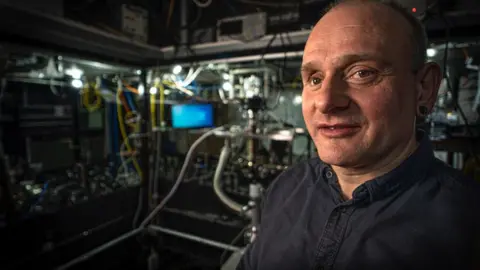
Fraunhofer ILT, a leading German research institution, has successfully developed a highly complex laser-optical system designed to precisely control 2,000 Rydberg atoms. This sophisticated system is a critical component for a quantum computer currently under construction at the 5th Institute of Physics at the University of Stuttgart. The technology allows researchers to position these atoms with extreme accuracy, down to submicrometer precision, within the computer's compact vacuum chamber. Essentially, it projects an array of 2,000 individually controllable laser beams that act like microscopic, invisible hands – often called optical tweezers – to hold the trapped Rydberg atoms at the exact distances required for them to interact and perform quantum computations.
WHO ARE THE KEY PLAYERS
**Fraunhofer Institute for Laser Technology (ILT)**: Based in Aachen, Germany, Fraunhofer ILT is one of the most important contract research and development centres for laser technology worldwide. It is part of the larger Fraunhofer-Gesellschaft, Europe's largest application-oriented research organization, known for bridging the gap between fundamental research and industrial application.
**University of Stuttgart, 5th Institute of Physics**: A public research university located in Stuttgart, Germany. Its 5th Institute of Physics is a key academic hub dedicated to advanced research in areas like quantum physics, atomic physics, and photonics, actively pushing the boundaries of scientific understanding and technological development in quantum computing.
**Rydberg Atoms**: These are atoms that have been excited to a very high energy state, causing their outermost electron to orbit much further from the nucleus than usual. This makes them exceptionally large and highly sensitive, allowing them to interact strongly with each other even over relatively long distances, a crucial property for storing and processing quantum information, known as qubits.
UNDERSTANDING THE LOCATION
The innovation stems from Germany, with **Aachen** being the base for Fraunhofer ILT and **Stuttgart** hosting the University's quantum computer project. Germany has a long-standing reputation as a powerhouse in scientific research and engineering, particularly in precision technologies and advanced physics. These cities, located in the western and southern parts of the country respectively, are part of a robust European research ecosystem that fosters high-tech advancements and international scientific collaboration.
BACKGROUND AND CONTEXT
Classical computers, like the ones we use daily, process information using bits that represent either 0 or 1. Quantum computers, however, use 'qubits' which can represent 0, 1, or both simultaneously through phenomena like superposition and entanglement. This allows them to process vast amounts of information exponentially faster for certain types of problems. The concept of quantum computing has been around for decades, but building a stable, scalable, and error-corrected quantum computer remains one of the greatest scientific and engineering challenges of our time. This latest development addresses a fundamental hurdle: precisely controlling and interacting with a large number of individual quantum particles, like Rydberg atoms, which are essential for creating functional quantum processors.
EXPLAINING IMPORTANT REFERENCES
**Quantum Computing**: Imagine a calculator that can try out all possible answers to a complex problem at the same time, instead of one after the other. That's the simplified idea behind quantum computing. It leverages the quirky rules of quantum mechanics – the physics of the very small – to perform calculations that are impossible for even the fastest traditional supercomputers. This could revolutionize fields from medicine to finance.
**Rydberg Atoms**: Think of a tiny solar system, where the electron is a planet orbiting the nucleus. In a Rydberg atom, that electron is pushed into a very wide orbit, making the atom much bigger and more reactive. This 'inflated' state allows these atoms to 'talk' to each other very effectively, which is exactly what's needed to build the connections (qubits) in a quantum computer.
**Laser-Optical System/Optical Tweezers**: Picture using incredibly focused beams of light like tiny, invisible hands to pick up, hold, and move microscopic objects without physically touching them. That’s what a laser-optical system, specifically employing optical tweezers, does. In this context, it uses 2,000 individual laser beams to precisely trap and position each Rydberg atom. The term "submicrometer precision" means positioning these atoms with an accuracy finer than a millionth of a meter, or roughly one hundredth the thickness of a human hair – an astonishing level of control.
IMPACT ANALYSIS
This breakthrough significantly advances the field of quantum computing by demonstrating unprecedented control over a substantial number of individual quantum bits. The ability to precisely position and manipulate 2,000 Rydberg atoms opens doors to building more complex and stable quantum processors. This could accelerate discoveries in areas like drug discovery, where quantum computers could simulate molecular interactions with far greater accuracy; materials science, enabling the design of novel materials with specific properties; and even artificial intelligence, by powering more sophisticated machine learning algorithms. While still in its early stages, this development brings the promise of practical quantum computing a step closer, potentially reshaping industries and solving problems currently deemed intractable.
WHAT HAPPENS NEXT
The immediate next steps involve integrating this laser-optical system fully into the University of Stuttgart's quantum computer and initiating extensive testing. Researchers will focus on improving the stability, coherence, and error rates of the quantum operations. The ultimate goal is to scale up the number of controlled qubits and develop robust error-correction mechanisms, which are crucial for building fault-tolerant quantum computers. While commercial applications are still some years away, this research lays vital groundwork, attracting further investment and talent into the burgeoning quantum technology sector globally.
HERO PERSPECTIVE
Leverage On Heroes Media views this scientific achievement as a testament to humanity's relentless pursuit of knowledge and technological advancement. This development underscores the critical importance of foundational research and international collaboration in tackling grand challenges. It serves as an inspiration, demonstrating that with focused effort and cutting-edge innovation, seemingly impossible technological feats can be achieved. We highlight this story to encourage greater investment in STEM education and research across Africa, emphasizing that participation in these global scientific frontiers is vital for our continent's future prosperity and technological self-reliance.
CLOSING
As the scientific community continues its quest for a fully functional quantum computer, the precise manipulation of 2,000 Rydberg atoms represents a monumental step. This German innovation brings us closer to a future where quantum technology could unlock solutions to some of the world's most complex problems, fundamentally altering our technological landscape.